


The Quest 3 has finally arrived! The latest virtual reality headset from Meta has some seriously high expectations, both as a “next generation” device, and for helping Meta compete in the area of Mixed Reality, just as Apple is set to ramp up interest in the space with the Vision Pro early in 2024. So let’s looks quickly at this new VR headset and answer some basic questions with my first impressions.
For those new to my style of reviews, these are not technical reviews, but more consumer reviews. I want anyone who is interested in virtual reality to know what this new headset is, and whether it’s worth dropping $500 to get (versus, you know, getting a PS5 or something). Here we go!
The previous headset, the Quest 2, lived a very long life for an emerging technology at THREE YEARS. For context the original Quest launched in 2019 and lasted one year before the Quest 2 replaced it in October 2020. So the market is now full of Quest 2 hardware, which Meta will continue to sell as an “entry level” device starting at $299. So what do you get for the extra $200? Many things it turns out. But we’ll keep this pretty high level.
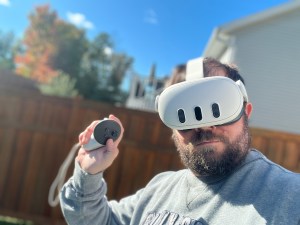
New Form Factor – the Quest 3 is a significant change from Quest 2. There is a claimed 40% reduction in size. Simply put, this thing feels way more like ski googles than the Quest 2 ever did. While it weighs roughly the same as the previous generation, the Quest 3 doesn’t feel as heavy because the weight is closer to your head. The lens are changed out for “pancake” style, which means they are thinner, and also they are larger, so you will have an increased field of view when you are in VR. The controllers changed too, ditching the rings that often caused confusion for new users (but did give us a handy way to “hang up” the controllers when not in use.) No more rings. The controllers are still tracked by the headset though, so no putting your arms behind your back (like you can with Quest Pro, which features self tracking controllers). So, big change in the physical headset that is VERY noticable visually and also when you wear it.
Software Updates – the headset is run by a much faster computer chip, which means games launch faster, and the headset can support higher quality graphics. Many game makers are already upgrading the graphics of their content libraries (including my fav, Walkabout Minigolf). The user interface is the same as Quest 2, so there isn’t a whole new ecosystem to learn thankfully.
Color Passthrough – I’m giving this topic it’s own section because for many it will be a huge selling point. And for Meta to compete in the Mixed Reality space, this feature needs to hit with consumers. On Quest 2 the passthrough camera revealed a grainy grey world when enabled. The passthrough wasn’t even intended to be functional beyond setting your “guardian space” when the Quest 1 originally launched. But as more folks want to play Mixed Reality games, or build experiences that overlay the physical space with digital experiences, the passthrough became more important to the product development team. The Quest Pro features the first “full color passthrough” but it was still pretty grainy, and without a depth sensor it was still just taking flat videos of your space, and wasn’t great at mapping physical objects (which is crucial for mixed reality).

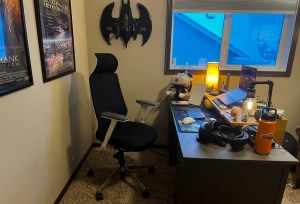
Notice these pics taken with Quest Pro (left) and Quest 3 (right). The first looks out my office window. The Quest Pro is a blown out light space and requires moving closer to the window to see building and objects. The Quest 3 is clear immediately. The second set of photos is my office desk. You’ll notice the Quest Pro (left) is more washed out and blurry, whereas the Quest 3 (right) has that pop of color. What you can’t see in the picture is that I can read the words on the world map on my desk with Quest 3, where with Quest Pro it’s all white blobs. So the passthrough upgrade is a true game changer for the Quest product line. I look forward to seeing what developers do with it. I’m already using it for Horizon Workrooms and Puzzling Places, and the upgrade is very noticeable.

One more demonstration of this new and improved Passthrough. The following were taken with the headset on my head, both the still image and the video. And it is pretty stunning.

If you have been enjoying the Quest 2 over the past three years and want to continue the experience of the best Mobile VR on the consumer market right now, then upgrading to Quest 3 is a good choice. I have been working in the VR space for almost 8 years, and I rarely experience the rush of the original days when I first strapped on the Gear VR and the HTC Vive, but I can honestly say that the Quest 3 blew my mind. Especially the Mixed Reality Demo that features aliens blasting through your walls and bouncing off your furniture, as you blast them with your ray guns. The experience reminded me of an old demo with the Magic Leap One, but since the passthrough is all video, the experience is seamless in both direct and peripheral vision (AR headsets are famous for their tiny field of view).
At the same time, the Quest 2 will continue to be a very good entry level headset. The vast majority of games will be backwards compatible, at least for a while. So if you aren’t in a rush to drop half a grand on a new headset, you aren’t being left behind. The move from Quest 1 to Quest 2 felt more like “to experience good VR you need to make the change”. The shift to Quest 3, while I’d say it is a more dramatic change this time around, it is at the same time a more tolerable shift, because the Quest 2 remains a very good VR headset, and will be a solid choice for a while into the future.
It’s worth noting that battery life continues to be an issue and there is some concern that by trying to keep things small while increasing the computing power we could see battery life drop. I will be paying attention to that as I use it. Also the stock headstrap, while I’d argue is modestly better than the Quest 2 stock strap, if you’re a regular user you will want to upgrade to an Elite style strap (and wait a month or so for the 3rd party companies, like Kiwi, to release solid solutions).
The Quest 3 is the VR headset the market has been waiting for these past 3 years. The Quest 2 served us well, and will serve as a solid workhorse for years to come, but the landscape of Virtual Reality is changing. The introduction of more Mixed Reality solutions and “Spatial Computing” concepts mean that Meta has to continue to push innovation or be left behind when companies like Apple make their play for the market.
The Quest 3 is an upgrade you feel every time you use it. It’s more like moving from PS3 to PS5, versus iPhone 13 to 15 (both jumps I’ve made myself recently). If you love VR this is a headset to get. Or you can hope you know someone who has one and ask them for a demo. I can pretty much guarantee you’ll have a blast.
More to come on the details as I use this headset over the next few weeks.
Cheers!





















 Carrier Pigeon XR